

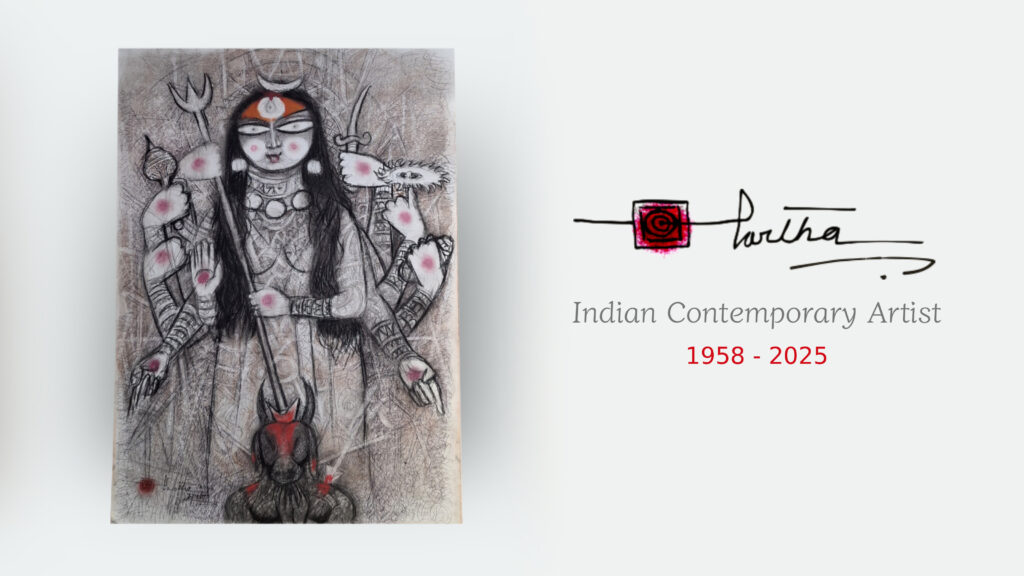
Among the works that Partha Bhattacharjee produced in the final chapter of his career, the Durga Series holds a particular place — not because it is technically the most ambitious, though it is considerable, but because it is the most theologically concentrated. These paintings, made in dry pastel and the visual idiom of rural West Bengal, carry the full weight of a lifetime of thinking about the divine feminine, compressed into images of extraordinary clarity.
The central motif says everything: a trident and a lotus, held in the same hand. The trident belongs to Durga — the warrior goddess, destroyer of evil, the fierce and uncompromising protector. The lotus belongs to Parvati — her gentle form, the devoted consort, the nurturer. These are not separate figures in Partha’s theology. They are one being, understood differently. The fighter and the lover as one truth. Strength and softness as two hands of the same self.
Where the Series Comes From
The Durga Series belongs conceptually to Partha’s Mahakal Series — the body of work in which his moral and spiritual convictions about peace, equality, and justice are expressed most directly. The Mahakal Series, produced in the 2010s, was itself a departure: a conscious move away from European influence and toward Indian forms, Indian subjects, Indian visual languages. The Durga Series, emerging in the final years of his life after the 2017 cerebral attack damaged his vision, represents the fullest flowering of that move.
The medium — dry pastel on paper — was chosen by necessity and discovered to be perfect. When the cerebral attack reduced Partha’s peripheral vision and his ability to focus precisely, oil painting became impossible. Pastel became his language: immediate, responsive, forgiving of the imprecision that his compromised eyes now brought. And the idiom of Bengal folk art, which he had absorbed across years of travel to Shantiniketan, Tarapith, and the Sundarbans, provided a visual language that was bold, direct, and spiritually serious in exactly the ways the Durga series required.
The Visual Language
The Durga paintings do not attempt photographic realism. They do not use the Trompe-l’oeil technique that characterised the Devi Series and made Partha’s reputation. Instead, they speak in a register that is older and more communal — the register of the village wall painting, the terracotta temple frieze, the Patachitra scroll. The outlines are bold. The colours are those of the natural world. These are paintings that feel as if they have always existed, as if Partha discovered rather than made them.
Which is, in the end, what he believed. The goddess, in his theology, was always there — in the women who struggle and endure, in the soil and the rivers, in the earth itself. His paintings were not inventions. They were recognitions.
For the Collector: What These Works Offer
For collectors drawn to Indian contemporary art with deep cultural and spiritual roots, the Durga Series offers something rare: the full force of a formally trained, internationally recognised painter working in an ancient visual language with complete fluency and genuine devotion. These are not academic exercises in folk style. They are paintings made by a man who believed in what he was painting — who was, at this point in his life, doing the only thing that mattered to him.
The courage behind that — the willingness to keep painting after a cerebral attack had taken much of his sight, to find new languages for convictions that had never changed — is present in every stroke. It is what makes these works worth acquiring: not just their beauty, which is considerable, but their integrity.
A full overview of Partha Bhattacharjee’s paintings across all his major series is available online in his website, alongside the opportunity to acquire pieces of Indian art from this extraordinary final period — paintings in which the trident and the lotus rest, as they always did, in the same hand.